Freeze the line
Pitch, contacts, stack, plating.
Multi-line comparison
Use one row per connector, not one row per factory slogan. LinkScope Sourcing 39 keeps pitch, plating, and quantity from collapsing into a single blended price. The workflow is a buying method. It is not an environmental program and it does not certify a plant.
Pitch, contacts, stack, plating.
Same row sent to each respondent.
Missing thickness or freight stays red.
Only equal scopes sit side by side.
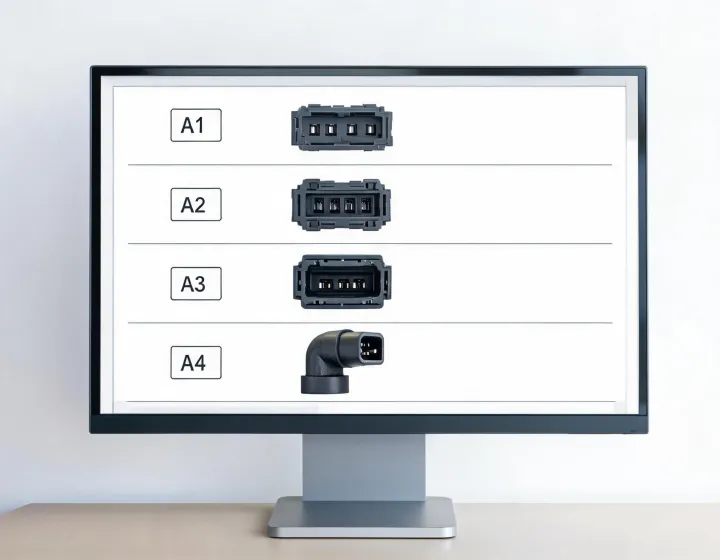
Manufacturer name as the factory writes it, exact model, drawing revision, and date-code rule. Board to board connector manufacturers sometimes answer with a series name. Send the row back until the model is specific. A series can hide a 0.50 mm and a 0.80 mm option.
Commercial columns: quantity, currency, per piece or whole order, Incoterm, and lead time basis. A 12-week figure without a start date is incomplete. Say whether the clock starts at drawing approval or at receipt of the brief.
Plating thickness in micrometres, connector mating cycle minimum, current at a named ambient, and impedance if the pair is 50 ohm or 100 ohm. Insertion loss and return loss columns stay blank unless the supplier names frequency and measurement accuracy. Do not fill them from a neighbor row.
Stack height, keying, and termination (SMT versus press-fit) are the choices most often left blank. An alternative that changes any one of them is a new row. Verify the PCB footprint, the voltage rating, and whether pick-and-place caps are included before you accept it. If ingress protection is claimed, ask which mated condition was tested.
Some programs refuse a second-source header because the host vendor support policy names one drawing. Others allow it after pinout, plating, and electrical limits match the exact board. Put the program rule in the BOM header so every factory sees it. LinkScope Sourcing 39 will not override that rule with a preference for high-end or budget suppliers. That preference only tells factories how much documentation you asked to see.
A new connector row can be quoted as pieces. A refurbished card row is a different commodity: condition, prior mating cycles, and license or firmware scope if the card is active. Mixing those rows under one unit price hides the risk. Keep them apart even when the connector family name matches. Neither path is endorsed here.
Environment: the buyer spreadsheet plus the supplier PDF, not a lab owned by this desk. Method: align model, pitch, plating, quantity, and Incoterm, then list deviations. Data: record the numbers the supplier printed, such as 0.76 um gold or 100 cycles, and the unit. Steps: freeze the row, send it, mark gaps, and only then look at extended price. If a gap remains, the result is a hold. That sequence can be repeated on the next revision without treating the first pass as a test certificate.
| Choice | Ask before accepting | Why the row splits |
|---|---|---|
| Gold thickness | 0.05 um flash versus 0.38 um or 0.76 um | Durability and price move together |
| Stack | 5 mm, 8 mm, or 16 mm | Card spacing is mechanical, not cosmetic |
| Termination | SMT or press-fit, and the board finish | Process at your assembler changes |
| Lot condition | New, unused surplus, or reworked | Cycle life already consumed is unknown until stated |
Limits of the workflow: it does not upload files, it does not rank factories, and it does not convert a budget into a unit price. Signal claims above the stated frequency range stay out of the total. If you need the attribute checklist in prose, use the procurement brief, the labels, or the RFQ lane.
No. Each pitch is a row. A blended price cannot be checked against a drawing.
Keep the original currency on the row. Convert only in a buyer column that shows the rate and the date you chose. Do not overwrite the factory number.
When both replies name the start event and whether tooling is included. A shorter week count with tooling excluded is not automatically earlier.
Paste the rows into the requirement. Include quantity, destination, and timing. Add currency and per-piece or whole-order basis if you have a budget figure. This call to action is a comparison request, not a line-card download.
Qualified business buyers
A confirmed benefit may be up to 3%.
Eligibility applies to qualified business buyers and is confirmed after we review your product, quantity, destination, and sourcing requirements.